THE ROCK & ROLL ARCHIVE | David Bowie | The Complete History of David Robert Jones
- Grant Gutterigde

- 13 hours ago
- 5 min read
PART TWO
1960–1963
The Bromley Boy and His First Bands
The teenage years that shaped a musical revolutionary
Introduction
By 1960, David Robert Jones was thirteen years old and living in Bromley, Kent. Britain was entering a new decade of optimism, youth culture was beginning to emerge as a powerful social force, and American music was capturing the imagination of teenagers across the country.
For David, these years marked the beginning of a lifelong search for artistic identity.
He was no longer simply a schoolboy with an interest in music. He was becoming a performer, a saxophonist, a songwriter and a student of modern culture. The influences that would later define David Bowie—rock and roll, rhythm and blues, modern jazz, theatre, fashion and visual art—were all beginning to converge.
This chapter follows David through his school years, his first bands, the friendships that would last a lifetime and the London music scene that ignited his ambition.
Britain Enters the Swinging Sixties
Although the phrase "Swinging London" would not become famous until the middle of the decade, the seeds were already being planted.
London's coffee bars, jazz clubs and dance halls were attracting young people eager for something new. American rhythm and blues records, often difficult to obtain, were treasured possessions among musicians. Skiffle had inspired thousands of teenagers to form bands, and a new generation was beginning to look beyond traditional pop music.
Artists such as Elvis Presley, Chuck Berry, Little Richard, Buddy Holly and Eddie Cochran became heroes to ambitious British teenagers.
David Robert Jones was one of them.
Bromley Technical High School
In 1961, David attended Bromley Technical High School for Boys, where his creativity flourished.
The school placed an unusually strong emphasis on art, music and design, giving him opportunities that would prove invaluable throughout his career.
His art teacher, Owen Frampton—the father of future guitarist Peter Frampton—recognised David's imagination and encouraged his interest in painting, design and visual communication.
Years later, Bowie would credit these lessons with helping him understand that popular music could be presented as a complete artistic experience, combining sound, fashion, theatre and visual imagery.
George Underwood – A Friend for Life
One of the most important friendships of David's youth was with George Underwood, a fellow pupil who shared his passion for music and art.
The two boys formed bands together, listened to imported American records and dreamed of making careers in music.
Their friendship became part of rock folklore after a schoolyard fight over a girl left David with a permanently dilated left pupil. Although often described as having "different coloured eyes", Bowie actually had a condition known as anisocoria, caused by the injury.
Far from ending their friendship, the incident strengthened it.
George Underwood later became a successful illustrator and created album artwork for Bowie, including the covers of Hunky Dory (inside artwork), The Rise and Fall of Ziggy Stardust and the Spiders from Mars, and several later releases, contributing to Bowie's visual legacy.
Terry Burns Opens New Doors
While school introduced David to formal education, his older half-brother Terry Burns expanded his intellectual horizons.
Terry was fascinated by modern jazz, literature and the Beat Generation.
He introduced David to artists including:
Charles Mingus
John Coltrane
Eric Dolphy
Thelonious Monk
He also encouraged him to read writers such as Jack Kerouac and Allen Ginsberg, exposing him to ideas about identity, freedom and artistic experimentation.
These influences would remain visible throughout Bowie's songwriting for the rest of his career.
The Gift of a Saxophone
In 1961, David persuaded his parents to buy him a Grafton plastic alto saxophone.
Rather than treating it as a hobby, he studied seriously under jazz musician Ronnie Ross, one of Britain's leading saxophonists.
Ross taught technique, discipline and musical theory.
Years later, in one of rock's most satisfying full-circle moments, Ronnie Ross played the memorable baritone saxophone solo on Bowie's 1975 hit "Walk on the Wild Side" by Lou Reed, which Bowie had produced.
The teacher had become part of the student's musical world.
Discovering London's Rhythm and Blues Scene
Although still too young to become a regular visitor, David followed London's growing rhythm and blues movement with fascination.
Clubs in Soho and the West End were introducing British audiences to music by:
Muddy Waters
Howlin' Wolf
Bo Diddley
Jimmy Reed
Young musicians including Mick Jagger, Keith Richards, Brian Jones, Eric Clapton and Alexis Korner were beginning to build the foundations of what would soon become the British blues boom.
David absorbed these developments eagerly, recognising that London—not New York or Liverpool—was where he wanted to build his future.
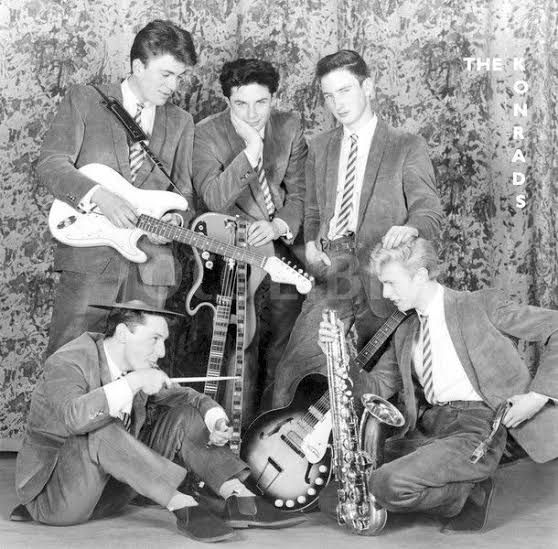
The Konrads
Around 1962, David joined The Konrads, generally regarded as his first serious band.
Initially playing saxophone before gradually taking on vocal duties, he gained invaluable experience rehearsing, performing and working with other musicians.
The Konrads performed at youth clubs, local halls and small events across South London and Kent. While the audiences were modest, these performances taught David how to command a stage and work with a band.
He also began writing songs and thinking about how image and presentation could distinguish an artist from the crowd.
Early Musical Influences
By the end of 1963, David's musical tastes had become remarkably broad.
He admired:
Elvis Presley
Little Richard
Chuck Berry
Buddy Holly
Eddie Cochran
Lonnie Donegan
Charles Mingus
John Coltrane
Ray Charles
Unlike many of his contemporaries, he refused to limit himself to one genre.
Rock and roll, jazz, rhythm and blues, folk and modern art all became part of his creative education.
That openness would later define David Bowie.
Rock Timeline: 1960–1963
1960
David begins to immerse himself in American rock and roll and jazz.
1961
Starts at Bromley Technical High School.
Receives his first saxophone.
Begins lessons with Ronnie Ross.
1962
Joins The Konrads.
Starts performing regularly with local musicians.
1963
Develops ambitions to become a professional performer.
London's rhythm and blues scene begins to flourish, providing inspiration for the next stage of his career.
Why These Years Matter
Many biographies focus on Bowie's later reinventions, but the foundations of those transformations were laid in these formative years.
At Bromley Technical School he learned to think visually.
From Terry Burns he learned to think intellectually.
From Ronnie Ross he learned musical discipline.
From The Konrads he learned performance.
Together, they created the young artist who would soon step into London's vibrant music scene in search of his first professional break.
Did You Know?
David's fascination with combining music, fashion, theatre and visual art began years before Ziggy Stardust. Even as a teenager, he believed a performer should create an entire world around their music rather than simply sing songs.
📍 Where Rock History Happened
Bromley Technical High School
What happened here?
David Robert Jones developed the artistic and musical foundations that would shape his future career. Encouraged by inspirational teachers and surrounded by lifelong friends, he began to imagine a career far beyond suburban South London.
Still standing?
The original school buildings survive as part of the educational campus, although the institution has changed over the years.
Can you visit today?
Yes, the site remains an important landmark for Bowie enthusiasts, though it functions as a working educational facility.
Featured Tour
🎸 Magical Music Tours – David Bowie Walking Tour
Explore the neighbourhoods where David Robert Jones grew up before following his journey into the clubs, studios and streets of Soho, where David Bowie would be born.
Featured Tour
🎸 Magical Music Tours – David Bowie Walking Tour
Visit Brixton, discover Bowie's early story and explore the places that shaped one of Britain's greatest musical pioneers before following his journey into Soho, the West End and beyond.
📆 Check the calander for availible times and dates.
🧑🧑🧒 If you wish to book a PRIVATE TOUR please email for details.
Next Chapter
1964–1965 – Finding an Identity
David Robert Jones leaves school, joins a succession of rhythm and blues bands, enters the vibrant world of Soho, works with his first professional managers, and adopts the name that will become known around the world:


Comments