THE ROCK & ROLL ARCHIVE |DAVID BOWIE | THE COMPLETE HISTORY OF DAVID ROBERT JONES

CHAPTER SIX
ZIGGY STARDUST | THE CREATION OF A ROCK & ROLL MESSIAH
1972 — THE YEAR DAVID JONES BECAME A STAR FROM ANOTHER PLANET

London was about to meet a visitor from the stars. He had flaming red hair a guitar slung across his body, and a message for a generation that no longer knew quite what to believe in. His name was Ziggy Stardust.
But Ziggy was more than a character. He was a calculated collision of rock and roll, science fiction, sexual ambiguity, Japanese avant-garde fashion and the ancient human desire to create a god.
And behind the glitter, the platform boots and the otherworldly stare stood a man who had spent years searching for a way to escape himself.
His name was David Robert Jones.
By 1972, he had already travelled through a bewildering succession of musical identities. There had been the earnest young mod, the folk storyteller, the psychedelic experimenter, the bewildered Major Tom and the velvet-voiced romantic of Hunky Dory. He had tasted critical acclaim without achieving the level of commercial success he craved.
He had watched other musicians find their audiences while he remained on the threshold.
Now, with The Rise and Fall of Ziggy Stardust and the Spiders from Mars, Bowie would stop waiting for the world to discover him.
He would create a world of his own and invite everyone inside.
This was the moment when David Bowie became more than a singer. He became a mythmaker, an architect of identity and one of the defining cultural figures of the twentieth century.
And London, with its dark Soho streets, theatrical stages, underground clubs and restless youth, would become the natural home of his greatest creation.
HADDON HALL THE LABORATORY OF REINVENTION
The transformation did not begin beneath the spotlights. It began at home.
At Haddon Hall in Beckenham, the Victorian house that had served as Bowie's creative sanctuary, David and his wife Angie lived amid a world of artistic experimentation. The house was more than a domestic refuge. It was a gathering place for musicians, artists, friends and fellow travellers who moved through Bowie's increasingly unconventional orbit.
Here, the boundaries between everyday life and performance began to dissolve.
Ideas were exchanged. Characters were invented. Music, theatre, fashion and philosophy collided.
Bowie was fascinated by the power of transformation the possibility that a person could become someone else through costume, gesture, voice and imagination. His interest in theatre, mime and performance had been developing for years, influenced in part by his earlier work with mime artist Lindsay Kemp. He understood that a performer did not simply sing a song. A performer could construct an entire universe around it.
Angie Bowie was an important presence during this period, helping shape the couple's theatrical surroundings and encouraging the bold, unconventional presentation that would become synonymous with Ziggy. Their relationship was complicated, but their shared appetite for experimentation formed part of the atmosphere in which Bowie's new identity emerged.
The house was a rehearsal space for a revolution.
The musical foundations were already in place. Bowie had recorded Hunky Dory in 1971, an album full of startling songwriting, from the futuristic uncertainty of Life on Mars? to the spiritual yearning of Quicksand and the alienated romance of Changes.
That last song would become an anthem for a generation learning that identity was not necessarily fixed.
Time may change me, but I can't trace time.
Bowie was about to take that idea to its most radical conclusion.
If David Jones could change, why couldn't he become Ziggy Stardust?
THE SPIDERS FROM MARS FOUR MEN, ONE EXPLOSION

A messiah needs disciples.
Bowie found his in three musicians whose chemistry would become inseparable from the Ziggy phenomenon: guitarist Mick Ronson, bassist Trevor Bolder and drummer Mick “Woody” Woodmansey.
Together, they became the musical force behind the Spiders from Mars.
Ronson was the essential counterweight to Bowie's theatrical imagination. A guitarist from Hull, he possessed a raw, muscular playing style that could cut through the most elaborate of Bowie's arrangements. He could be delicate when the music demanded tenderness, then unleash a wall of distortion that made the stage feel as though it were about to collapse.
His arrangements brought a grandeur to Bowie's songs, adding strings, piano and orchestral colour without sacrificing the electricity of a rock band.
Ronson was not merely accompanying Ziggy.
He was helping build the cathedral in which Ziggy would preach.
Trevor Bolder provided the bass foundations, while Woodmansey's drumming supplied the momentum and swagger that drove the songs forward. Their collective sound was tight, aggressive and theatrical, yet capable of extraordinary musical sensitivity.
The Spiders were not simply hired musicians standing behind a star. Their sound gave Ziggy his physical presence.
Onstage, the relationship between Bowie and Ronson became a performance within the performance. Ronson's powerful guitar work and composed stage presence contrasted with Bowie's increasingly fluid movements, provocative gestures and otherworldly persona.
The tension between them was electric.
One was the guitar hero; the other, the alien rock god.
Together, they helped create a new visual and musical language for British rock.
The transformation was already beginning to take shape onstage in early 1972. At the Friars Club in Aylesbury on 29 January, Bowie and his band performed material from the forthcoming album, months before Ziggy became a household name.
David Bowie
It was a small beginning for a character who would soon occupy some of the biggest stages in Britain.
And Bowie was only getting started.
TRIDENT STUDIOS BUILDING THE SOUND OF ZIGGY

The next stage of the transformation took place in the recording studio.
In London, Trident Studios in Soho had become one of the most important recording facilities in British popular music. Its technical capabilities, distinctive sound and proximity to the West End made it a natural home for ambitious musicians who wanted to push beyond conventional recording techniques.
Bowie had already recorded Hunky Dory there. Now he returned with a more focused vision, working with producer and engineer Ken Scott to create an album that would sound like the soundtrack to a collapsing civilisation.
The songs were cinematic. The guitars were fierce. The melodies were immediate, but the stories beneath them were unsettling.
The album was not a straightforward concept record with a neatly defined plot. Instead, Bowie assembled a series of songs that created an interconnected mythology around a doomed rock star, an approaching apocalypse and a world desperately searching for salvation.
There was the seductive promise of Starman, the urban menace of Suffragette City, the swaggering self-destruction of Ziggy Stardust and the desperate romanticism of Lady Stardust.
Then there was Rock ’n’ Roll Suicide, a finale that transformed the alienated outsider into a figure of almost religious compassion.
The record moved between glamour and catastrophe, tenderness and aggression, fantasy and uncomfortable reality.
It was rock and roll as theatre.
Yet beneath the science fiction was something deeply human. Bowie understood that young people often felt like strangers in the world their parents had constructed. Ziggy offered them a way to turn that estrangement into something powerful.
Being different was no longer a problem to be solved.
It was a badge to be worn.
Released on 16 June 1972, The Rise and Fall of Ziggy Stardust and the Spiders from Mars would become the album that transformed Bowie's career. It eventually reached No. 5 on the UK albums chart, establishing itself as a landmark of British glam rock.
Official Charts
The record's legacy would extend far beyond its original chart run.
But before the world could fully understand Ziggy, it needed to see him.
And that meant fashion.
THE MAKING OF AN ALIEN KANSAI YAMAMOTO, RED HAIR AND THE NEW SEXUALITY

Ziggy's appearance was not an afterthought.
It was part of the music.
Bowie had long understood that clothing could communicate ideas before a singer uttered a single word. His earlier flirtations with mod fashion, folk romanticism and theatrical costume had prepared him for something more radical.
Now he would draw on the avant-garde designs of Japanese fashion designer Kansai Yamamoto, whose bold silhouettes, vibrant colours and futuristic creations offered a visual language unlike anything ordinarily seen on British pop television.
Yamamoto's designs helped Bowie imagine a performer who did not belong to the everyday world.
Ziggy could be both masculine and feminine, beautiful and unsettling, glamorous and grotesque. His clothes appeared to come from a future in which the boundaries of gender and conventional respectability had dissolved.
The impact was immediate.
Bright colours. Sculptural shapes. Platform boots. Dramatic makeup. A body transformed into a work of art.
Costume designer Freddie Burretti also played a significant role in shaping the Ziggy-era look, creating striking outfits that combined theatrical extravagance with elements of street style and science fiction.
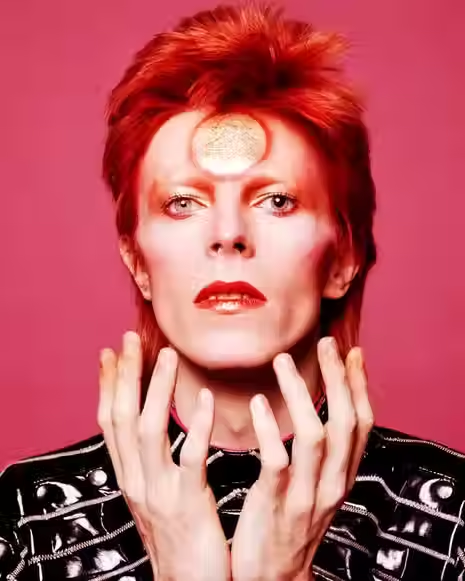
Then there was the hair.
The flaming red Ziggy cut was applied by Suzi Fussey, the girlfriend of guitarist Mick Ronson. Inspired by an image associated with Yamamoto's designs, Bowie adopted a sharp, sculptural hairstyle that made him instantly recognisable.
It was a radical departure from the softer, more conventional appearance of his earlier career.
The transformation was complete.
David Jones, the boy from Brixton, had become a figure who appeared to have stepped out of a futuristic comic book.
Yet Ziggy's greatest provocation was not the clothes. It was the freedom they represented.
In early-1970s Britain, attitudes towards sexuality and gender expression remained deeply conservative. Bowie challenged those conventions through his androgynous appearance, ambiguous persona and refusal to behave like a conventional male rock star.
He was not simply dressing differently.
He was questioning who had the right to define what normal looked like.
For young people who felt isolated, misunderstood or trapped by expectations, Ziggy offered a glimpse of another possibility.
You could invent yourself.
You could change.
You could become extraordinary.
And you did not need anyone's permission.
And then came the face.
The Ziggy makeup would eventually become one of the most iconic images in popular culture.
A pale face.
Heavy makeup.
The transformation was complete.
David Jones had disappeared.
David Bowie was now playing Ziggy Stardust.
HEDDON STREET THE NIGHT ZIGGY CAME TO EARTH
There is a small street just off Regent Street in London's West End that has become one of the most recognisable locations in rock history.
Heddon Street.
Today, the street's association with Bowie attracts music fans from around the world. But in January 1972, it was simply a London street on a cold, wet night.
Photographer Brian Ward was working from a studio at 29 Heddon Street. Bowie stepped outside for a series of photographs, eventually posing beside the entrance at No. 23, with his guitar and an expression that seemed to suggest he had arrived from somewhere beyond the human world.
A telephone box nearby.
A dark London street.
And above him, the famous sign:
K. WEST.
The original photographs were taken in black and white. Artist Terry Pastor later hand-coloured the image selected for the album sleeve, giving Ziggy's outfit its now-famous blue appearance.
Bowie's pose was casual, almost indifferent.
He stood beneath the street sign, one foot resting on a raised step, appearing less like a pop star posing for publicity than a visitor waiting for someone to collect him.
The result became one of the defining album covers in music history.

The photograph was a masterclass in visual storytelling.
The street was ordinary. The figure was extraordinary.
London's everyday world and Bowie's imagined universe had collided in a single frame.
And the location was no accident of geography. Soho and the surrounding West End had long been places where outsiders, performers, artists and night-time wanderers could find their people. The district's theatres, clubs, fashion boutiques and recording studios offered a natural environment for Bowie's increasingly theatrical vision.
The Ziggy image captured that atmosphere.
It was urban, mysterious and slightly dangerous. There was no elaborate stage set, no futuristic spacecraft and no expensive production.
Just a man, a guitar and a London street.
Yet the photograph would help turn Ziggy Stardust into a global icon.
A commemorative plaque now marks the location, giving visitors a physical connection to the moment when Bowie's fictional alien became permanently attached to the real geography of London.
For anyone tracing Bowie's life through the capital, Heddon Street is more than a photo opportunity.
It is a meeting point between David Robert Jones and the mythology he created.
Stand there today and the question almost asks itself:
Was Ziggy simply a character Bowie played, or was he the person Bowie had been trying to become all along?

STARMAN THE NIGHT BRITAIN MET THE MESSIAH
The album had been released. The image was taking shape. The live performances were
becoming more theatrical.
But Ziggy still needed an audience.
That breakthrough arrived with Starman.
Released as a single in April 1972, the song offered something deceptively simple: a message from beyond the stars, promising hope to young people who felt disconnected from the world around them.
It was science fiction disguised as a pop song, with a chorus that seemed designed to be shouted by anyone who had ever felt different.
Then came Thursday, 6 July 1972.
The BBC broadcast Bowie's performance of Starman on Top of the Pops, recorded the previous day at Television Centre in White City. Bowie appeared in a striking multi coloured outfit alongside the Spiders from Mars, with Mick Ronson standing close beside him.
As the performance unfolded, Bowie draped his arm around Ronson.
It was a seemingly simple gesture, but in the context of early 1970s British television, it was a startling image. Bowie appeared playful, intimate and utterly unconcerned with conventional expectations of masculine rock-star behaviour.
Millions of viewers encountered something they had rarely seen presented so confidently in the living rooms of mainstream Britain.
The performance became a defining moment in Bowie's rise to stardom, inspiring countless young viewers and future musicians.

For some, it was the first time they had seen someone who seemed to embody their own feelings of difference.
For others, it was an invitation to question the rules.
And for the music industry, it was a warning that the old boundaries of pop were beginning to crumble.
Bowie had found his audience.
The alien had made contact.
From that moment, the Ziggy phenomenon gathered momentum. The record-buying public, the music press and the television audience began to recognise the same extraordinary figure.
The carefully constructed mythology was becoming a reality.
And London was at the centre of it.
SOHO AFTER DARK THE STAGE BECOMES A WORLD
To understand Ziggy Stardust, you must understand the world in which he moved.
London in 1972 was a city of contrasts. The economic optimism of the previous decade had begun to give way to uncertainty, while young people were experimenting with music, fashion, sexuality and new forms of self-expression.
The West End was a natural meeting place for these ideas.
In Soho, musicians and aspiring performers moved between recording studios, clubs, pubs and small venues, searching for audiences and opportunities. The Marquee Club in Wardour Street had already hosted generations of influential performers, including Bowie during his earlier years, when he was still developing his musical identity.
It was a world away from the polished glamour of mainstream television.
Here, reputations could be made in a single performance or destroyed just as quickly.
Bowie understood the power of these spaces. A club was not merely a place to play music. It was a theatre in which the audience could become part of the performance.
The Ziggy shows increasingly blurred the distinction between concert and spectacle. Bowie moved, posed and interacted with the audience as though he were inhabiting a role in a play. The Spiders provided the soundtrack, while the costumes, lighting and gestures transformed the stage into another planet.
The songs were no longer isolated pieces of music.
They were scenes in an unfolding drama.
And the audience was not simply watching a performer.
It was witnessing the creation of a star.
As the tour grew, Bowie's performances became more ambitious. The Rainbow Theatre in Finsbury Park, a former cinema converted into a major live venue, provided a grander setting for the Ziggy phenomenon. London was no longer merely the place where the character had been invented. It had become one of the principal stages on which he came alive.
The city's streets, venues and studios formed an invisible backdrop to the spectacle.
From the creative sanctuary of Haddon Hall to the recording rooms of Trident, from the clubs of Soho to the street corner immortalised on the album sleeve, Bowie's London was a map of reinvention.
Each location marked another step in his transformation.
The boy from Brixton was becoming a cultural force.
But the greater Ziggy's fame became, the more complicated the relationship between the character and the man beneath the makeup would become.
THE MESSIAH AND THE MESSAGE WHAT ZIGGY REALLY MEANT

The mythology of Ziggy Stardust is often reduced to its most immediately recognisable elements: the red hair, the costumes, the platform boots and the lightning bolt that would become associated with Bowie's later Aladdin Sane persona.
But beneath the imagery lay a darker story.
Ziggy was an outsider who became a saviour. He arrived with a message of hope, offering salvation through music to a generation facing an uncertain future. Yet he was also a rock star, vulnerable to ego, excess and the destructive demands of fame.
He could inspire devotion, but he could not escape the consequences of being worshipped.
The character's rise contained the seeds of his downfall.
In Ziggy Stardust, Bowie described a performer whose success and self-importance ultimately consumed him. In Rock ’n’ Roll Suicide, the album's final track, the narrative shifted from the grand mythology of the alien messiah to a direct, emotional address to the isolated individual.
The message was intimate rather than cosmic.
You were not alone.
That was the paradox at the heart of Ziggy. The character appeared larger than life, but his appeal depended on reaching people who felt small, powerless or invisible.
Bowie understood that pop music could create a community out of alienation.
A song could become a secret shared between strangers. A costume could become permission to live differently. A television performance could change the way a young person imagined their future.
Ziggy gave outsiders a language.
He made theatricality a form of freedom and turned reinvention into an art form.
His influence would reach far beyond the glam rock era, helping shape generations of performers who understood that music was not only something you heard. It was something you could see, inhabit and become.
Yet Bowie was already moving forward.
The genius of David Jones was that he could build a mythology and then refuse to remain trapped inside it.
The creation of Ziggy Stardust was a triumph.
It was also the beginning of a dangerous question.
What happens when the character becomes more famous than the person who created him?
THE END IS ALREADY BEGINNING
By the end of 1972, David Bowie was no longer the struggling musician who had spent years searching for a breakthrough.
He had become one of Britain's most compelling performers, a songwriter with an extraordinary visual imagination and an artist capable of transforming the expectations of popular culture.
The success of The Rise and Fall of Ziggy Stardust and the Spiders from Mars had given him something he had wanted for years: an audience prepared to follow him into the unknown.
But Bowie was not interested in standing still.
Even as Ziggy's fame grew, he was developing new ideas. His next musical world was already beginning to emerge, drawing on the sounds and influences that would shape Aladdin Sane in 1973.
The new character would be darker, more fractured and more visibly connected to the pressures of celebrity.
The famous lightning-bolt makeup would come to define that next stage of his transformation, but the seeds of it were already present in Ziggy's story: the tension between public image and private identity, between artistic freedom and commercial success, between the desire to be worshipped and the fear of losing control.
Bowie had created a rock and roll messiah.
Now he would have to decide how long he could survive as one.
The London streets that had helped give Ziggy his identity would remain part of the story. Heddon Street preserved the image. Soho preserved the atmosphere. The recording studios and performance venues preserved the traces of the work that made the transformation possible.
And somewhere beneath the red hair, the costumes and the mythology, David Robert Jones remained the restless young artist who had always understood that identity could be reinvented.
Ziggy Stardust had arrived from the stars.
But his creator was already preparing for the next journey.
THE LONDON TRAIL FOLLOWING ZIGGY STARDUST
1. Brixton | Where David Robert Jones Began
The starting point of Bowie's extraordinary journey: his birthplace in south London, where the story began long before the world knew the name Ziggy Stardust.
2. Heddon Street | The Ziggy Stardust Album Cover
Stand at the location immortalised on the 1972 album sleeve and discover how a rainy London night produced one of rock's most enduring images.
3. Trident Studios | Where the Sound Took Shape
Explore Soho's recording history and the studio associated with Bowie's groundbreaking early-1970s work.
4. Wardour Street and Soho | The Music Scene
Discover the clubs, studios and streets that helped make London's West End a vital part of Bowie's musical story.
These locations form part of the wider story explored through London's music history. Buildings and businesses change, so check current access arrangements before visiting individual interiors.
Featured Tour
🎸 Magical Music Tours David Bowie Walking Tour
Visit Brixton, discover Bowie's early story and explore the places that shaped one of Britain's greatest musical pioneers before following his journey into Soho, the West End and beyond.
📆 Check the calendar for available times and dates.
🧑🧑🧒 If you wish to book a PRIVATE TOUR please email for details.
TO BE CONTINUED…
CHAPTER SEVEN
ALADDIN SANE | ZIGGY CONQUERS AMERICA
LONDON • NEW YORK • LOS ANGELES • HOLLYWOOD • PHILADELPHIA
THE SPIDERS FROM MARS • GLAM ROCK • FAME • THE CREATION OF ALADDIN SANE
Ziggy Stardust had conquered Britain. Now David Bowie was preparing to take his creation across the Atlantic.
America would provide a new audience, new obsessions and a fresh set of contradictions. The journey would help inspire a darker alter ego: Aladdin Sane, the cracked reflection of a rock star caught between fame, fantasy and the disorientating reality of life on the road.
The next transformation was already waiting.
And the lightning was about to strike.


Comments